

Shutdown Standoff: When ICE Walks and Rhode Island Workers Pay
How a DHS funding fight in Washington could squeeze Rhode Island families while leaving ICE largely untouched

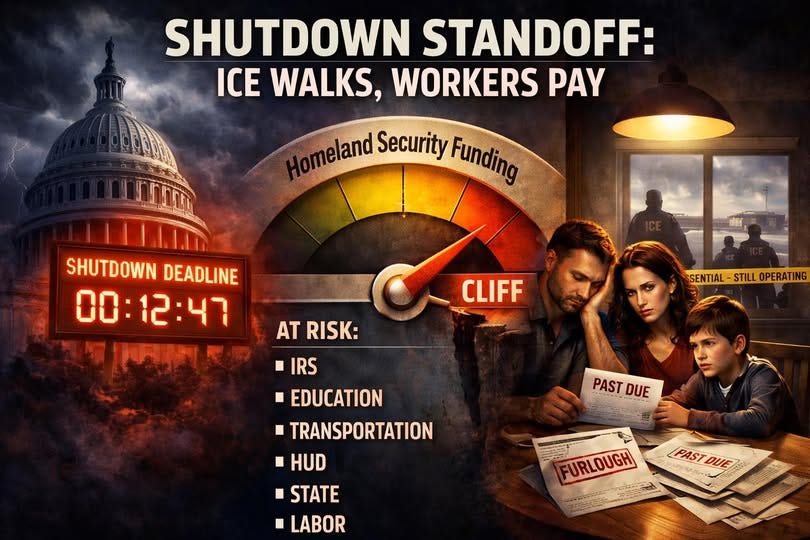
Congress is steering us back toward another shutdown cliff, and this time the fight is centered on how far ICE and other immigration agencies should be allowed to go after the killing in Minneapolis. Senate Democrats say they will vote no on the new Homeland Security funding bill unless it includes real safeguards, transparency, and tighter rules on lethal force. Republicans, who already pushed a DHS bill through the House, insist they will not reopen it and accuse Democrats of trying to “defund enforcement” instead of fixing specific abuses. The result is a high‑stakes standoff with a shutdown deadline days away.
If nobody moves, this doesn’t become a clean up‑or‑down vote on ICE. Instead, we get another “partial” shutdown that lands on everyone else. The same bill that funds Homeland Security also carries money for a stack of civilian agencies: Treasury and the IRS, Education, Transportation, HUD, State, Labor, and major pieces of DHS itself. When that money runs out, big parts of these agencies have to freeze normal operations. Many civilian employees are sent home without pay. Others are told they’re “essential,” ordered to keep working, and handed an IOU until politicians finish their game of chicken.
For Rhode Island, that looks like federal workers and contractors suddenly unsure which paycheck actually arrives, families waiting longer for tax refunds they were counting on, and people running into delays on passports, student aid, and housing or transportation projects. TSA agents and other safety staff at T.F. Green could be stretched thinner. Disaster‑response and security planning might slow down just when we need them to be most reliable. None of that shows up in a D.C. soundbite, but it’s exactly what people feel when the government “partially” shuts down.
Here’s the kicker: the enforcement agencies at the center of the outrage—ICE and Border Patrol—are the least likely to feel the squeeze. Their agents are classified as “excepted” in shutdown plans, which means they keep reporting for duty even if other parts of government go dark. On top of that, ICE and CBP were already handed a big multi‑year funding boost in last year’s giant spending package, money they can keep drawing on even if this year’s DHS bill dies on the Senate floor. In plain English: the fight is “about” ICE, but a shutdown triggered by that fight doesn’t actually shut ICE down.
That’s what makes this moment so backwards. The risk isn’t that Washington will suddenly pull the plug on aggressive immigration enforcement. The risk is that, once again, ordinary workers, families, and core services become leverage. Paychecks and basic functions are put on the line so both parties can posture over who is “tough” or “soft” on ICE, while the actual enforcement machinery continues operating with fewer new guardrails than the public was promised.
Rhode Island Pulse exists to cut through that spin. Rhode Islanders deserve to know exactly who is being used as a bargaining chip in this shutdown standoff—and it isn’t the agencies walking the line in Minneapolis headlines. It’s the people opening “FURLOUGH” pay stubs and “PAST DUE” notices while the Capitol clocks keeps ticking.