

Rhode Island Families Aren’t Asking for This
When the State House Targets Self‑Checkout Lanes and 32‑Hour Gimmicks Instead of Skyrocketing Bills

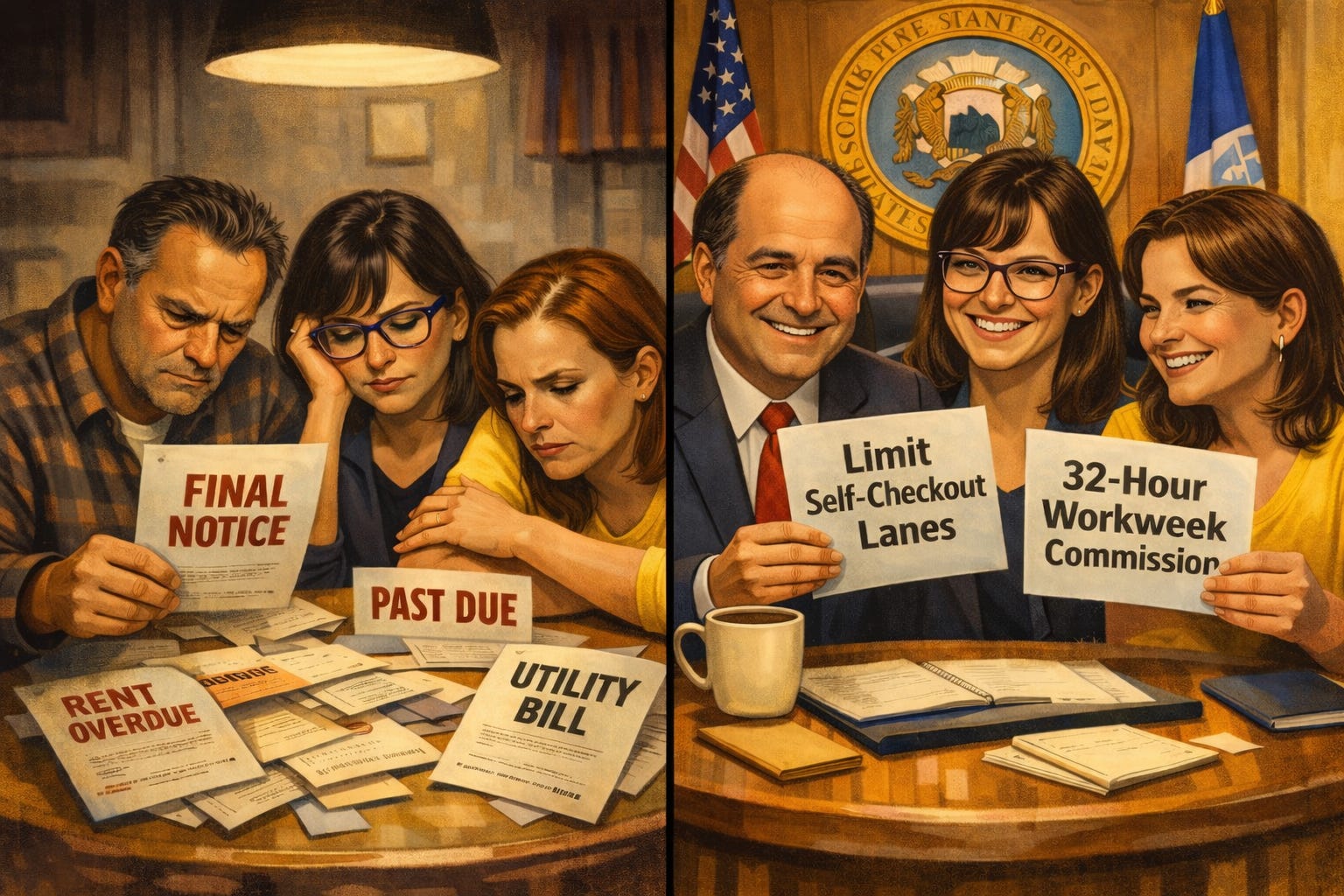
Rhode Island families are not asking for this
Rhode Islanders are told every election that the people on Smith Hill are “fighting for working families.” Then you look at what actually makes it onto the agenda, and you start to wonder who exactly they think those working families are.
This week, the House Labor Committee, chaired by Rep. Arthur Corvese, is taking up a slate of bills that says a lot about the priorities inside the State House. One bill from Rep. Megan Cotter would regulate how many self‑checkout lanes a grocery store can operate and how many staff must be assigned to monitor them. Another bill from Rep. Karen Alzate would mandate that large employers with 500 or more workers move to a 32‑hour workweek while still paying the equivalent of 40 hours, with anything over 32 counted as overtime. A third Alzate bill would create a commission to “study” reducing the standard workweek from 40 hours to 32.
Ask yourself: did any Rhode Islander you know wake up today thinking, “My top concern is too many self‑checkout machines”? Is anyone sitting at their kitchen table saying, “If only the General Assembly would create another commission, my life would finally get easier”?
Meanwhile, real people are buried under bills that actually matter: rent and mortgages that keep creeping up, property taxes that never seem to level off, electric and gas bills that spike every winter, health insurance premiums and co‑pays that make you think twice about going to the doctor, and grocery receipts that look like car payments. Families aren’t looking for symbolic fights over supermarket layouts. They’re trying to figure out how to stay in their homes, keep the lights on, and put food on the table.
Proponents will say this agenda is about “workers’ rights” and “dignity.” But if you talk to small and mid‑sized employers, a mandated 32‑hour workweek paid like 40 doesn’t sound like dignity; it sounds like a math problem that ends with higher prices, fewer jobs, or businesses deciding Rhode Island just isn’t worth the trouble. It’s one thing for a company to voluntarily offer shorter weeks or flexible schedules. It’s another thing entirely for politicians to impose a one‑size‑fits‑all mandate and hope the consequences work themselves out later.
The same is true with self‑checkout. There are legitimate questions about theft, automation, and customer service. Those are real debates. But instead of tackling wages, training, or enforcement, the legislature’s answer is to micromanage how many scanners a store can plug in. That’s not structural reform; it’s central planning theatre.
This is the gap that keeps growing in Rhode Island politics: the distance between what people are actually living with and what their elected officials choose to spend time on. Inside committee rooms, lawmakers chase headlines and craft talking points. Outside, in cramped apartments and modest homes, families sit under harsh kitchen lights sorting through “past due” notices and wondering which bill they can afford to skip this month.
Rhode Island doesn’t need more symbolic battles or commissions destined to generate reports that gather dust. It needs a laser focus on affordability, housing supply, utility costs, healthcare access, and a functional mental health and addiction system. It needs policies that make it easier to build, work, hire, and stay here, not ideas that make for clever press releases but shaky paychecks.
If this is what passes for a labor agenda in 2026, the problem isn’t just a few bad bills. It’s a political culture that confuses activity with progress and optics with outcomes. Until we start sending people to the State House who live in the same economic reality as the rest of Rhode Island, we’re going to keep seeing the same show: struggling families on one side of town, and on the other, a legislature earnestly solving problems almost nobody actually has.